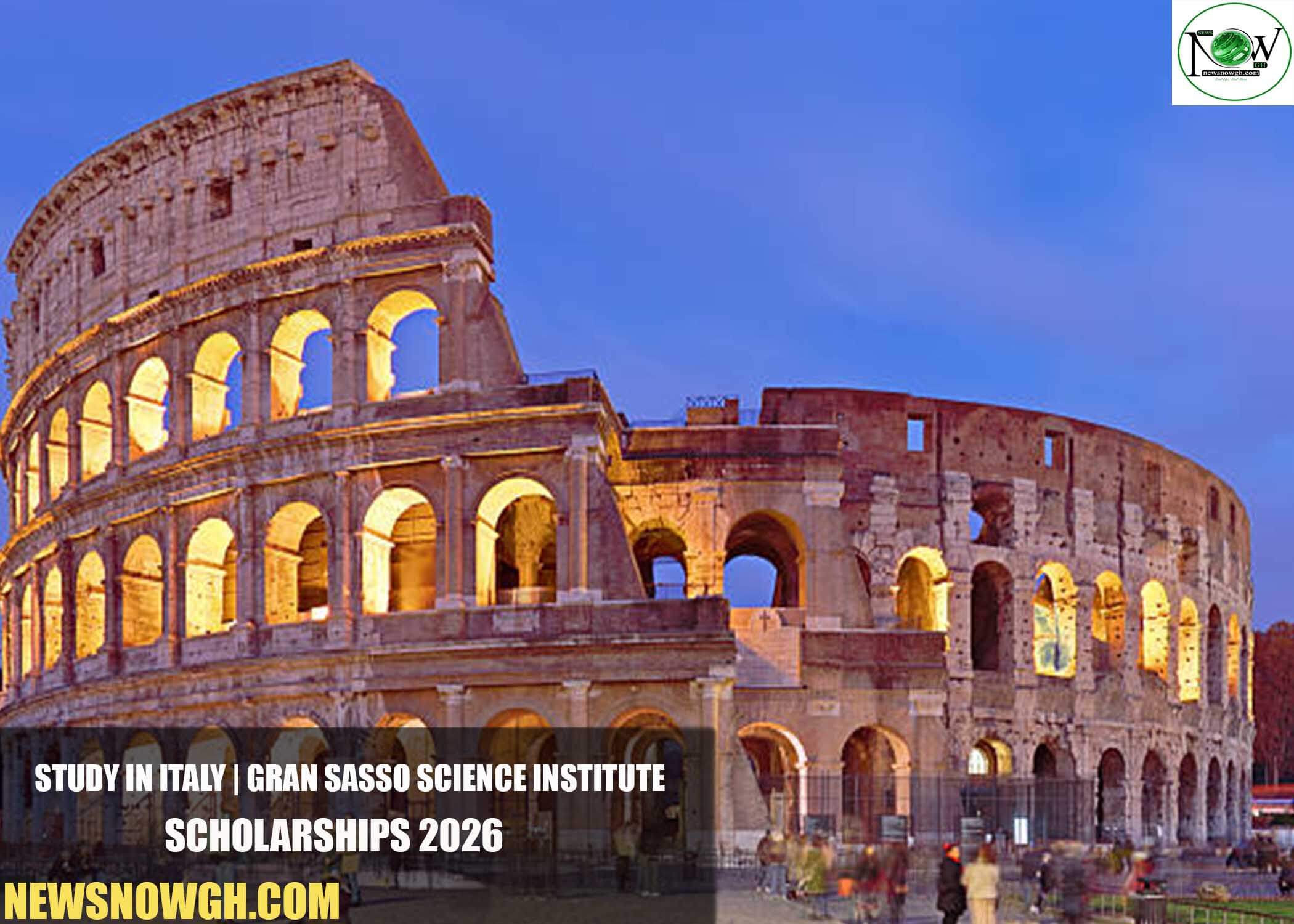
Study in Italy | Gran Sasso Science Institute Scholarships 2026
Italy’s Gran Sasso Science Institute has opened one of the more research intensive PhD admissions cycles in Europe for 2026. The institute offers funded doctoral positions in Astroparticle Physics and Computer Science with international research exposure, accommodation support, and additional project backed scholarships tied to advanced European research initiatives. For students targeting frontier areas like dark matter detection, gravitational wave systems, theoretical computer science, or formal program verification, the GSSI call focuses on recruiting highly research oriented candidates into specialized laboratories and collaborative projects.
The GSSI PhD Programmes 2026 in Italy open themselves to international applicants holding eligible master’s level qualifications or equivalent foreign degrees. The funded doctoral positions cover tuition waivers, annual scholarships worth €16,243 gross, housing support, meal benefits, insurance, and additional research mobility funding. The programmes conduct themselves entirely in English and begin in November 2026.
Research Focused PhD Tracks With Project Based Funding
Unlike many broad doctoral admissions rounds across Europe, the Gran Sasso Science Institute structures several of its funded positions around active international research projects. In Astroparticle Physics, applicants can compete not only for standard GSSI scholarships but also for additional positions connected to the AstroCent Plus initiative and the FIS Project on gravitational wave detection systems.
Some of the funded physics profiles involve:
- Machine learning control systems for the Virgo detector
- Reinforcement learning for gravitational wave observatories
- Dark matter detection technologies linked to the DarkSide 20k experiment
One selected candidate under the AstroCent+ collaboration may also spend a year in Warsaw as part of the programme’s international research network.
The Computer Science programme follows a similar pattern. Beyond standard scholarships, additional positions tie themselves to research in distributed computation and the ERC funded SPES project focused on SMT solving and formal verification. The programme strongly targets applicants interested in algorithms, logic, computational mathematics, and theoretical computer science rather than general software engineering profiles.
What the GSSI Scholarships Actually Cover
The financial package is stronger than many standard European doctoral offers, particularly considering the cost structure of L’Aquila compared with larger Italian cities. Here is what successful candidates receive:
- Annual Gross Scholarship Funding: €16,243
- Research Abroad Increase: 50 percent during approved stays overseas
- First Year Accommodation: Free housing or €350 monthly housing substitute
- Tuition Fee Waiver: No academic fees
- Free Meal Vouchers: During working days
- Insurance Coverage: For academic activities
- Laptop Reimbursement: Up to €1,200 for research related purchases
The PhD programmes officially last four years. Students may qualify for the doctoral degree after the third year depending on academic progress.
Who Can Realistically Compete for Admission
The GSSI call opens itself globally. However, the selection process clearly favors academically strong candidates with a demonstrated research orientation. English proficiency is mandatory. You must hold either an Italian Laurea Magistrale equivalent qualification or a foreign university degree with at least four years of study.
For Computer Science, the institution openly encourages candidates from mathematics backgrounds. They particularly seek those interested in algorithms and theoretical computation. In Astroparticle Physics, applicants must demonstrate alignment with advanced interdisciplinary physics research rather than general physics coursework alone.
This is not a high volume admissions model designed for large international intakes. The relatively limited number of scholarships, combined with the research specialization of the positions, means applicants with clear academic direction will stand out. Strong thesis work helps. Convincing research motivation also distinguishes you from candidates relying primarily on grades.
Application Materials and Programme Expectations
Submit your application through the official GSSI online portal. Required materials include:
- Valid identification documents
- Academic transcripts
- Degree certificates
- Curriculum vitae
- Motivational letters
- Programme specific research documentation
Astroparticle Physics candidates must additionally provide an extended abstract of their master’s thesis. Computer Science applicants must submit a research project describing the topics they aim to pursue during their doctoral studies.
Reference letters are optional but can be submitted through the official referee system. Shortlisted applicants will later face interviews conducted in English, either remotely or in person depending on institutional arrangements.
How to Apply
Application Deadlines
The last date to apply for the Italian Gran Sasso Science Institute Scholarships Astroparticle Physics is 28 May 2026. Applications for Computer Science, excluding the FIS funded position, close on 5 June 2026.
Why This Italian PhD Call Stands Out
Many fully funded European PhD opportunities advertise broad research themes but provide limited clarity about the actual scientific work students will join. The GSSI 2026 intake is unusually transparent about the laboratories, technologies, and computational problems tied to its funded positions. This makes the programme particularly attractive for applicants who already know the kind of research ecosystem they want to enter.
For candidates hoping to build careers in advanced scientific computing, theoretical algorithms, astroparticle physics, or large scale European research collaborations, this admissions cycle offers something increasingly rare in doctoral education. You gain early integration into active international research infrastructure rather than generalized coursework driven doctoral training. Visit the GSSI website today, review the full programme details, and prepare your application before your target deadline. Your funded PhD in Italy awaits.
RECOMMENDED
- Study in USA | University of South Carolina Scholarships 2026
- Study in Qatar | Hamad Bin Khalifa University 2026 Scholarships
- Study in Turkey | Türkiye Başarı Burs Programı 2026
- Study in China | USTC International Winter Camp 2026
- Study in UK | University of Cambridge Herchel Smith Postdoctoral Fellowships 2026
- Study in UK | Oxford University MSc African Studies Scholarships 2026-27
- Study in China | Chinese Government Scholarship Fully Funded 2026 at Nanjing University